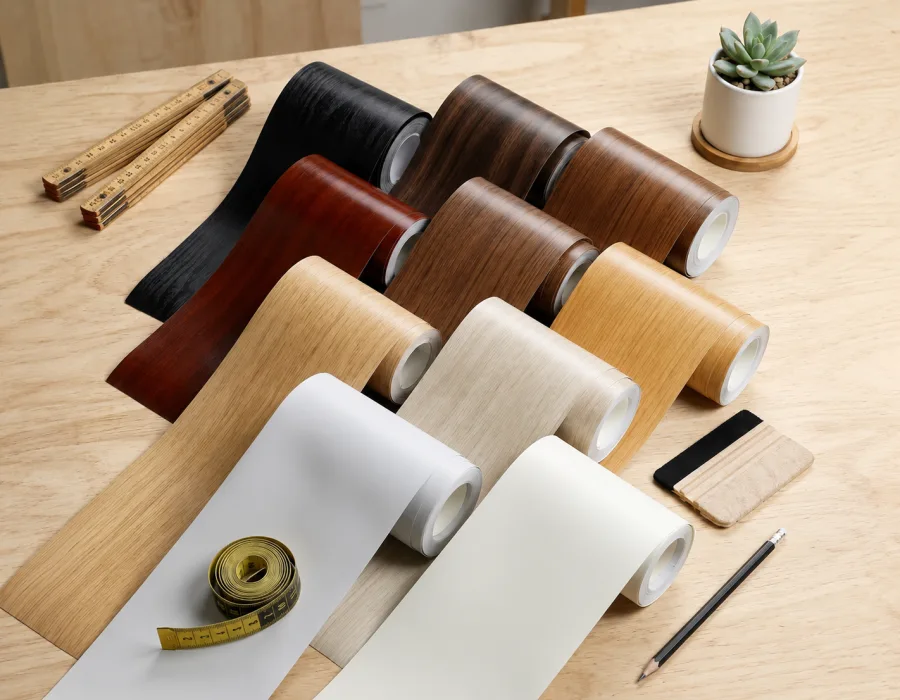
One of the most critical yet least talked-about stages of furniture production is edge banding. If the raw edge left exposed after cutting isn't protected, materials like MDF and particleboard swell and deteriorate on contact with moisture, shortening the furniture's lifespan. At Bektaş Mobilya, our workshop in Tuzla offers precise edge banding in PVC and ABS, color- and texture-matched to the panel finish — whether it's for furniture we manufacture ourselves or parts you bring in purely for edge banding.
What Is Edge Banding, and Why Is It Necessary?
Edge banding is the process of pressing a thin strip of material — matched in color to the panel's surface finish — onto the raw edge left exposed after cutting, using a hot-melt adhesive. Skip this step and:
- the panel edge absorbs moisture and eventually swells and deforms,
- sharp, rough edges create a risk of chipping and impact damage during everyday use,
- the furniture looks unfinished, mismatched against its own surface finish.
That's why edge banding is an inseparable part of durability and aesthetics in kitchen cabinets, wardrobes, shelving, and any panel-based furniture.
PVC vs. ABS Edge Banding
PVC Edge Banding
A widely used, economical option. Its broad range of colors and patterns makes it the standard choice for most furniture projects.
ABS Edge Banding
Offers higher impact resistance, better color stability, and a more environmentally friendly composition compared to PVC; it's preferred for heavily used pieces such as kitchen cabinets or applications where a longer service life is expected.
We help you decide which banding type suits your project based on expected usage intensity and budget.
Our Edge Banding Process
- Band and color selection: the banding type, thickness (typically between 0.4 mm and 2 mm), and color are matched to the panel finish.
- Adhesive application: the band is pressed onto the panel edge using a heat-activated hot-melt adhesive.
- Trimming: excess overhanging band is precisely trimmed away.
- Edge rounding and scraping: the join between band and panel is finished smooth, with no rough edge to the touch.
- Final inspection: bond quality and edge integrity are checked before the part moves on to the next production stage (assembly or delivery).
Benefits of Edge Banding
- Protection from moisture: prevents water/moisture absorption through exposed edges, stopping the panel from swelling.
- Impact resistance: reinforces edges against everyday bumps and friction.
- Aesthetic integrity: matching band gives the furniture a seamless, single-piece look.
- Longer service life: a properly banded panel can go years without edge deterioration.
How Edge Banding Relates to Cutting
Edge banding is typically applied right after CNC cutting or panel sizing — the panel is cut to size first, then the exposed edges are banded. That's why we can offer edge banding as part of a single production flow together with our cutting service, or entirely on its own, for panels you've already had cut elsewhere.
Factors That Affect Pricing
- Band type (PVC or ABS) and thickness
- Total edge length to be banded (linear meters)
- Number of panels/parts
- Color and texture matching precision (rare or special colors can extend sourcing time)
For an exact price, we review your panel details and banding preference and prepare a quote tailored to your project.
Where It's Used
Our edge banding service is regularly used by furniture makers producing kitchen cabinets and wardrobes, small carpentry workshops without their own edge-banding machine, and furniture businesses that need extra capacity for a specific production batch.
Our Service Area
We provide edge banding from our workshop in Tuzla, covering Pendik, Kartal, and the entire Anatolian side of Istanbul.